Pasar al contenido principal
Inicio

Navegación principal

  • El área
    • Inicio
    • Bioinformática traslacional
    • Systems Medicine
    • Computational Biology Unit
    • Ofertas de trabajo
    • Our Team
    • INB Functional Genomics
    • Ciberer
    • Location
  • Publicaciones
  • Proyectos
    • Nuestros proyectos
    • COVID Circuit
    • iRWD
    • Scourge
    • CSyF SARS-CoV-2 Seguimiento Andalucía
    • Covid-19 Drug Repurposing
    • Pilot WES Lung Cancer
    • HoliRD
    • Pan(AI)Rep
    • Disease Maps
    • Mlfpm
    • Undiagnosed Rare Diseases Programme (ENoD)
    • Proyecto Genoma 1000 Navarra (NAGEN 1000)
    • Sponsors
  • Utilidades
    • Our tools
    • Hipathia
    • Cov-hipathia
    • Csvs
    • SPACNACS
    • SMAca
    • Tftea
    • Metabolizer
    • Mignon
    • Collaborations
    • Discontinued tools
  • Recursos
    • Resources overview
    • Surveillance circuit
    • Siega
    • Cov-hipathia
    • Csvs
  • Eventos
    • Resumen de eventos
    • Difusión de eventos
    • Jabi 2023
    • CAMDA
    • Jabi 2024
  • Courses
    • Cursos
    • Our Courses
  • Novedades
  • Colaboradores
Menú de cuenta de usuario
  • Iniciar sesión

Ruta de navegación

  1. Inicio
  2. Discontinued Tools
  3. GEPAS

Collaborations

Select a tool in the table to view the content

Title Description
PTMCode

The database of post-translational modifications within and between proteins

SNPeffect

on-line prediction of effects of protein-coding variants

DBAli

Pairwise and multiple protein structure alignments

SARA

Functional annotation of RNA structures

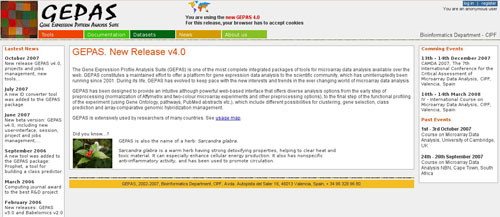
GEPAS : Microarray data analysis

gepas

GEPAS: A web-based tool for microarray data analysis and interpretation

GEPAS was one of the most complete and extensively used web-based packages for microarray data analysis. During its more than 10 years of activity it has continuously been updated to keep pace with the state-of-the-art in the changing microarray data analysis arena. In 2013 GEPAS was discontinued and all its functionality was implemented in Babelomics.

GEPAS offered diverse analysis options that included well established as well as novel algorithms for normalization, gene selection, class prediction, clustering and functional profiling of the experiment. New options for time-course (or dose-response) experiments, microarray-based class prediction, new clustering methods and new tests for differential expression wer included in subsequent versions.

An extensive re-engineering of GEPAS was carried out which included the use of web services and Web 2.0 technology features, a new user interface with persistent sessions and a new extended database of gene identifiers. GEPAS has been the most quoted web tool in its field and it has been extensively used by researchers of many countries. GEPAS statistics indicate an average usage rate of 500 experiments per day.

All the functionality of GEPAS, is now available within Babelomics http://www.babelomics.org.

Subir ⬆
image chatbot Pregunta al Chatbot
Logo junta de andalucía blanco

Copyright © Andalusian Platform for Computational Medicine - 2017/2023, FPS 

The ultimate objective of the Area is to bring to the clinician complex algorithms for the management of complex genomics data in a transparent way for them, which ultimately foster the adoption of innovative technologies in the current clinical practice.

Menu

  • Inicio
  • Herramientas
  • Publicaciones
  • Contacto
  • Ubicación
  • Acceso

Síguenos

  • Youtube
  • X
  • Política de privacidad