
Bioinformatics Tools
Select a tool in the table to view the content
| Title | Description |
|---|---|
| impuSARS | SARS-CoV-2 whole-genome Imputation |
| HiPathia | Mechanistic models of signaling pathways |
| CoV-HiPathia | Mechanistic models of the COVID-19 disease |
| CSVS | A crowdsourcing database of the Spanish population genetic variability |
| SPACNACS | Crowdsourcing initiative to provide information about Copy Number Variations of the Spanish population to the scientific/medical community |
| SMAca | SMA Carrier Analysis tool |
| TFTEA | Transcription Factor Target Enrichment Analysis |
| Metabolizer | Differential metabolic activity and discovery of therapeutic targets using summarized metabolic pathway models |
| MIGNON | A versatile workflow to integrate RNA-seq genomic and transcriptomic data into mechanistic models of signaling pathways |
| ngsCAT | Next Generation Sequencing data Capture Assessment Tool |
Snow : Network enrichment of a set of genes
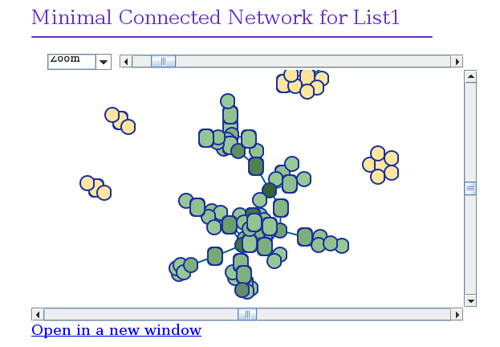
SNOW: Studying Networks in the Omic World
SNOW stands for "Studying Networks in the Omic World" and complements tools such as FatiGO and Marmite (Babelomics suite) introducing a new dimension in the functional profiling of high-throughput experiments results, this is, protein-protein interaction data. SNOW extracts and evaluates the cooperative behavior of lists of selected proteins/genes using the interactome as scaffold.
SNOW identifies hubs and evaluates the global degree of connections, centrality and neighborhood aggregation of the list by comparing the distributions of nodes connections degree, betweenness centrality and clustering coefficient respectively against the complete distribution of these parameters into the interactome of reference. Besides this, SNOW extracts the minimum network that connects the proteins/genes in the list. A user-fixed number of external proteins to connect nodes in the list is allowed. The topology of this network is evaluated by comparing distributions of graph parameters of this network against pre-calculated distributions of a set (10000) of random lists with same size range. By this, SNOW extracts information about whether the network represented in the list has more hubs, is more connected or has a more regular connections distribution than a random network.SNOW also provides an interactive visualization of the network and a complete description of interatomic and local network parameters of each protein/gene in the list as well as the external nodes introduced by the program. This information together with the functional annotation provided will guide the user to identify the important nodes within, or even outside, the list as well as evaluate the modular functionality of the list as an entity.
More info at: http://snow.bioinfo.cipf.es
Publication
- Minguez P, Gotz S, Montaner D, Al-Shahrour F, Dopazo J. 2009. SNOW, a web-based tool for the statistical analysis of protein-protein interaction networks. Nucl. Acids Res.; 37:W109-114