
Bioinformatics Tools
Select a tool in the table to view the content
| Title | Description |
|---|---|
| impuSARS | SARS-CoV-2 whole-genome Imputation |
| HiPathia | Mechanistic models of signaling pathways |
| CoV-HiPathia | Mechanistic models of the COVID-19 disease |
| CSVS | A crowdsourcing database of the Spanish population genetic variability |
| SPACNACS | Crowdsourcing initiative to provide information about Copy Number Variations of the Spanish population to the scientific/medical community |
| SMAca | SMA Carrier Analysis tool |
| TFTEA | Transcription Factor Target Enrichment Analysis |
| Metabolizer | Differential metabolic activity and discovery of therapeutic targets using summarized metabolic pathway models |
| MIGNON | A versatile workflow to integrate RNA-seq genomic and transcriptomic data into mechanistic models of signaling pathways |
| ngsCAT | Next Generation Sequencing data Capture Assessment Tool |
GEPAS : Microarray data analysis
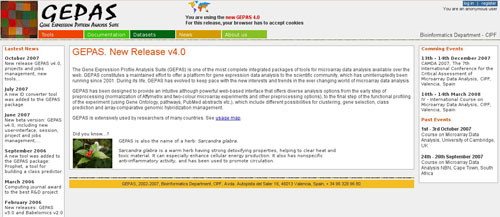
GEPAS: A web-based tool for microarray data analysis and interpretation
GEPAS was one of the most complete and extensively used web-based packages for microarray data analysis. During its more than 10 years of activity it has continuously been updated to keep pace with the state-of-the-art in the changing microarray data analysis arena. In 2013 GEPAS was discontinued and all its functionality was implemented in Babelomics.
GEPAS offered diverse analysis options that included well established as well as novel algorithms for normalization, gene selection, class prediction, clustering and functional profiling of the experiment. New options for time-course (or dose-response) experiments, microarray-based class prediction, new clustering methods and new tests for differential expression wer included in subsequent versions.
An extensive re-engineering of GEPAS was carried out which included the use of web services and Web 2.0 technology features, a new user interface with persistent sessions and a new extended database of gene identifiers. GEPAS has been the most quoted web tool in its field and it has been extensively used by researchers of many countries. GEPAS statistics indicate an average usage rate of 500 experiments per day.
All the functionality of GEPAS, is now available within Babelomics http://www.babelomics.org.