
Bioinformatics Tools
Select a tool in the table to view the content
| Title | Description |
|---|---|
| impuSARS | SARS-CoV-2 whole-genome Imputation |
| HiPathia | Mechanistic models of signaling pathways |
| CoV-HiPathia | Mechanistic models of the COVID-19 disease |
| CSVS | A crowdsourcing database of the Spanish population genetic variability |
| SPACNACS | Crowdsourcing initiative to provide information about Copy Number Variations of the Spanish population to the scientific/medical community |
| SMAca | SMA Carrier Analysis tool |
| TFTEA | Transcription Factor Target Enrichment Analysis |
| Metabolizer | Differential metabolic activity and discovery of therapeutic targets using summarized metabolic pathway models |
| MIGNON | A versatile workflow to integrate RNA-seq genomic and transcriptomic data into mechanistic models of signaling pathways |
| ngsCAT | Next Generation Sequencing data Capture Assessment Tool |
DBAli : Pairwise and multiple protein structure alignments
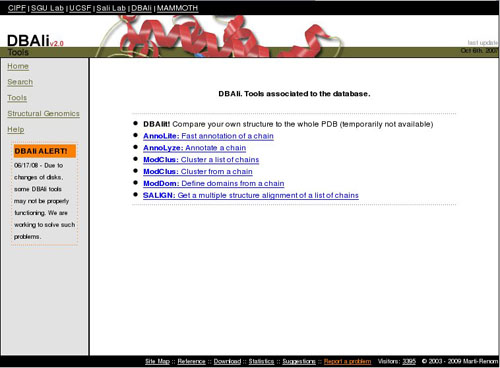
Advances in structural biology have resulted in a rapid increase in the number of experimentally determined protein structures. There is a need for an up-to-date comprehensive database of pairwise and multiple structure-based alignments for families of related proteins as well as tools to automatically and comprehensively generate, store, and analyze these alignments. We aim to provide some of this functionality to the biological community.
DBAli stores pairwise comparisons of all structures in the Protein Data Bank calculated using the program MAMMOTH. It also contains multiple structure alignments generated by the SALIGN command of MODELLER. DBAli is updated weekly. As of August 2007, DBAli contains ~1.7 billion pairwise comparisons and over 12,500 family-based multiple structure alignments for ~35,000 non-redundant protein chains in the PDB.
DBAli, a database of pairwise and multiple structure alignments, also integrates tools for dynamically establishing relationships between protein structures and their fragments. The utility of the database is illustrated by outlining several of its current applications. The DBAli database is accessible via the World Wide Web at http://www.dbali.org